THE LEAD ENGINE
A shadow-first outreach machine that refuses to guess
The Problem
Most lead-generation automation is built around a single metric: volume. Scrape more, message more, book more. The conversion funnel is treated as a numbers game where sending to bad addresses, anonymous handles, and probable noise is just the cost of doing business. Spam filters, domain blacklists, and burned sender reputations are externalities the tools don't track and the operators don't feel — until they do.
I needed something different. The target was outreach to independent trade businesses — real companies, real owners, real inboxes. The kind of contact where a cold message from an automated pipeline, if it lands badly, costs a human relationship and a brand reputation that can't be repurchased with a retry.
The requirement was an engine that would err on the side of silence. One that would rather report “uncontactable” than send into the void.
Chapter 1 — The Pipeline That Refused
The first version targeted social-signal sources: community posts where small business owners describe operational pain in their own words. It produced 42 leads and wrote 126 personalized outreach drafts against them. The copy was specific, relevant, and referenced the exact phrasing each prospect had used.
Then the pipeline reached the contact step — and stopped.
Every one of those 42 leads was an anonymous or pseudonymous poster. No verifiable business name. No domain to query. No address to validate. The system had built a first-class drafting machine pointed at a list it could not, with any integrity, call contactable. So it didn't. It reported the status as UNCONTACTABLE and queued the drafts — not for sending, but for the day the discovery layer could surface real contacts behind them.
126 drafts written. Zero sent. The pipeline called the list what it was — and that honesty was the design, not a failure.
This was the pivotal moment in the system's architecture. The temptation in v1 is always to ship the spray. The system was built to resist that temptation structurally — not through policy, but through the absence of a send path for unvalidated contacts.
Chapter 2 — Named Businesses, Earned Contacts
v2 rebuilt the discovery layer on a different premise: start with named businesses, not anonymous signals. Public map data, queried by craft and trade tags, surfaces real companies with real presences — a business that shows up in a public directory is a business that has chosen to be found.
A search-API pass extends coverage beyond what any single map source holds, adding a third-metro sweep that discovered 45 more named businesses, with email harvest still pending at time of writing.
The crawler is explicitly polite. It identifies itself with a custom User-Agent, enforces a hard limit of one request per second per host, and reads robots.txt before touching any page. Several sites declined — their exclusion directives were honored and those businesses were skipped. Not as a compliance formality, but because a scraper that ignores robots.txt is a scraper that's already started the relationship on bad terms.
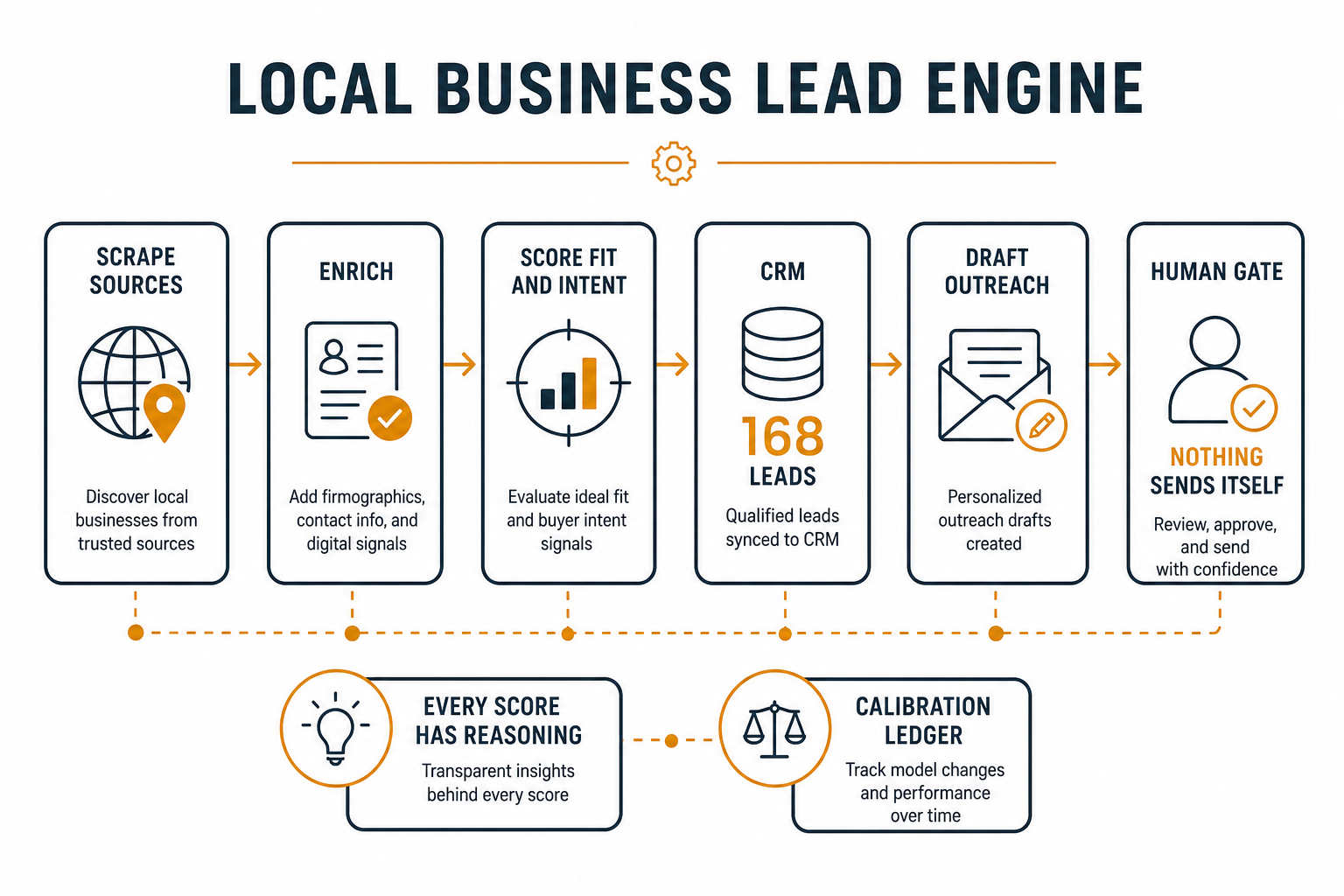
Email addresses are harvested only from a business's own website — specifically from their contact pages and footer — and every address is stored with its source URL as provenance. The system knows not just that it has an address, but exactly where it found it. DNS MX record validation runs on every harvested address: if the domain doesn't have mail infrastructure, the contact is flagged before it ever enters the drafting queue.
Every email address in the CRM carries its source URL. The system can prove where it found the contact — not just that it found one.
Ethics as brand protection. The rate limit, robots.txt compliance, and provenance recording aren't compliance theater. They're the difference between a system that could be explained to a prospect and one that couldn't. If a business owner ever asked “how did you find me?” the honest answer is: their own contact page, fetched once, politely, with the URL on record. That answer is defensible. A bulk-scraped dump with no provenance is not.
Craft Details
Provenance chain. Each CRM contact record stores: the source map or search result that named the business, the specific page URL where the email was found, and the MX validation result. The chain is auditable end-to-end — every contact can be traced back to its public source without touching any third-party data broker.
Draft quality bar. Drafts reference the prospect's business category and observed operational context. The personalization comes from public signals, not inferred private data. The output is specific enough to not read as a template, but sourced entirely from information the business put into the world itself.
Numbers on disk (2026-07-14). 18 named businesses discovered across two US metros, 5 MX-verified email addresses confirmed deliverable, 45 additional businesses discovered in a third-metro search-API pass with harvest pending. CRM total: 155 contacts, 126 queued drafts.
Stack
Chapter 3 — The Shadow Floor
The engine has no send path. This is not a gap in the implementation — it is a deliberate architectural choice. Every outreach draft that clears MX validation enters a queue visible to the operator. Nothing leaves that queue without an explicit human grant scoped to a specific batch. The grant does not exist yet.
This is the same logic applied in every autonomous system I build: built does not mean armed. A capability that can act unilaterally before it has earned a track record is a liability, not an asset. The shadow floor is the receipts period — the interval during which the system proves it can produce contactable leads, well-sourced addresses, and relevant drafts, before it gets the authority to send any of them.
Reply rate: UNMEASURED. Conversion: UNMEASURED. Open rate: UNMEASURED. Nothing has been sent. These metrics will exist when the operator makes the call to open the gate — not before.
155 contacts. 126 drafts. Reply rate: UNMEASURED — because nothing has been sent, and that is exactly the point.
The machine is ready. The receipts are accumulating. The cliffhanger is intentional: an outreach system that asks permission before it acts is a system worth trusting when it finally does.